
Smart film costs depend on glazing, wiring, controls, installation, and commissioning; PDLC suits retrofit privacy, while switchable glass is a complete glazing system.
When people search for smart glass price, they are usually trying to answer a practical question: What will this system cost for my building, and which technical choice will prevent unexpected costs later? A practical starting point is the smart film cost guide.
The difficulty is that “smart glass” does not describe one standardized product. A retrofit PDLC film, laminated switchable glass, and a dynamic exterior window such as SPD film can have very different material assemblies, electrical requirements, installation methods, and performance objectives.
A reliable estimate therefore cannot be based on glass area alone. It must account for the glazing type, panel dimensions, substrate condition, wiring, controls, access, testing, and commissioning.
Smart film is generally evaluated as a retrofit system, while switchable glass is evaluated as a complete glazing assembly. The most economical technical option depends on whether the project prioritizes interior privacy, solar control, thermal performance, architectural integration, or minimal disruption.
There is no responsible universal figure for smart glass cost because the installed system is made up of several separate components:
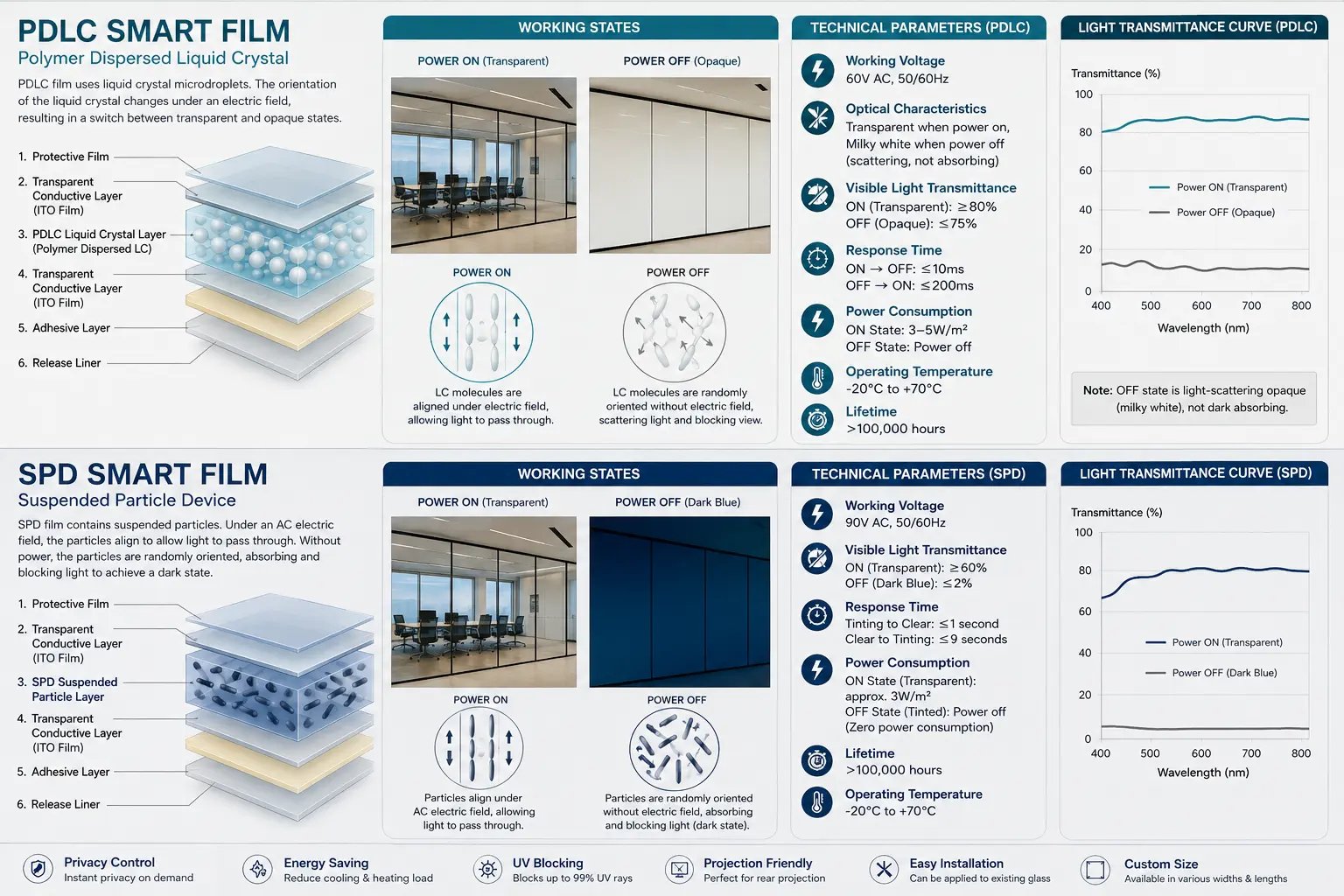
Published cost references also show why online figures should be treated cautiously. The Government of Alberta Infrastructure notes that PDLC film and PDLC glass have separate material and operating costs, while also excluding certain project accessories from its indicative figures. Its guidance further warns that exterior suitability can be limited by climate and application conditions. See Government of Alberta Infrastructure.
The more useful question is not “What is the unit price?” but:
What is the total installed cost of the required function, and what technical risks are included or excluded from the estimate?
Area is important, but it is not the only pricing variable. Small projects may carry a relatively high proportion of fixed costs because transformers, control equipment, site preparation, engineering coordination, and mobilization do not reduce proportionally with area.
Large projects may benefit from repetition and standardized panel sizes, but they can also introduce more complex wiring, zoning, access, and commissioning requirements.
The following factors usually have the greatest influence:
| Cost driver | Why it matters |
|---|---|
| Total glass area | Determines the quantity of active material |
| Individual panel size | Large panels require stricter handling and installation control |
| Number of unique sizes | Increases fabrication, labeling, and coordination effort |
| Retrofit or new construction | Retrofit work often involves more preparation and disruption |
| Existing glass condition | Surface defects, contamination, sealant, and curvature affect installation |
| Electrical zoning | More independently controlled zones require additional wiring and controls |
| Frame and edge details | Determine how wires are concealed and protected |
| Site access | Height, restricted access, and occupied spaces increase installation complexity |
| Environmental exposure | Outdoor applications require more rigorous product validation |
| Testing and handover | Commissioning requirements affect the complete system scope |
The Lawrence Berkeley National Laboratory COMFEN cost guidance makes the same broader point for window systems: cost depends on project size, location, labor market, contractor experience, season, and system scope. It recommends using imperfect but early cost information rather than postponing cost analysis until late design, when value-engineering changes are more disruptive. See Lawrence Berkeley National Laboratory — Cost Feature.
Smart film is often considered the lower-disruption option because it can be applied to suitable existing glass. Smart film vs smart glass, by contrast, is normally fabricated as a laminated or insulated glazing assembly.
That does not mean film is automatically the lowest-cost solution in every project. The comparison should include the complete installation:
For an occupied office, healthcare area, hospitality space, or meeting room, the reduced demolition and disruption of a retrofit film can be more valuable than a simple material comparison. For new construction, integrated switchable glass may provide a cleaner assembly with better control over safety glass, insulation, acoustic performance, and edge protection.
The terms are often used interchangeably, but they can refer to different scopes.
Smart film generally refers to an active PDLC layer applied to an existing glass surface. Its primary function is usually privacy control:
A film installation does not automatically improve the thermal performance of the entire window. The existing glass, frame, air leakage, and solar exposure still determine much of the envelope performance.
A smart window usually refers to a complete glazing unit or window assembly. Depending on the technology, it may be designed for:
The ISO 9050 standard identifies light transmittance, solar direct transmittance, total solar energy transmittance, and ultraviolet transmittance as separate glazing characteristics. These should not be collapsed into a single “transparency” number when evaluating a window system. See ISO 9050 — Glass in building.
PDLC can reduce glare and alter the amount and distribution of transmitted light, but its energy effect depends strongly on the system construction and control strategy. For additional context, see this heat rejection window film guide.
PDLC primarily changes the optical condition through light scattering. It is therefore not automatically equivalent to an absorbing or tinting technology that substantially reduces solar heat gain.
The Lawrence Berkeley National Laboratory explains that PDLC changes the window from a clear state to a light-scattering state and may be most appropriate for privacy applications. It also notes that scattering materials can remain visually bright when backlit by direct sun. See LBNL — Innovative Glazing Materials.
Published studies demonstrate the importance of project conditions:
The relevant studies are Evaluation of building energy and daylight performance according to applying electrochromic and PDLC and Evaluation of Energy and Daylight Performance of Old Office Buildings in South Korea.
These results should not be used as a guaranteed savings percentage. They indicate that energy performance is possible, but only when the active layer, base glazing, orientation, climate, and controls are assessed together.
In common PDLC configurations, electricity is required to maintain the transparent state. The exact operating demand depends on film construction, area, voltage, controller design, and test conditions. Detailed electrical data is available in the PDLC specifications.
The Government of Alberta Infrastructure identifies continuous power requirements as an operating consideration for PDLC and gives an indicative value of approximately 5 W/m² for maintaining transparency in the referenced system. Independent laboratory research also found that electrical consumption changes with film area, thickness, and applied voltage. See Performances of Polymer-Dispersed Liquid Crystal Films for Smart Glass Applications.
This creates an important design distinction:
The control philosophy should be established before the system is selected.
A useful estimate should be divided into cost layers rather than presented as one unexplained unit figure. An early area-based calculation can be supported by the smart film cost calculator.
Define:
Define:
Define:
Define:
The following checklist is more reliable than calculating area alone. For detailed preparation, review the smart film installation guide.
For a project-specific review of dimensions, substrate, electrical zoning, and installation conditions, use the elevatoX project specification review before treating any online figure as a budget allowance.
The correct comparison is not only between material prices. It is between operating functions.
| Requirement | PDLC smart film | Curtains or blinds | Frosted or etched glass | Fixed privacy film |
|---|---|---|---|---|
| Instant privacy change | Strong | Limited by mechanical movement | None | None |
| Clear view when privacy is not needed | Yes, subject to optical specification | Yes when open | No | No |
| Electrical dependency | Yes in common configurations | Usually no | No | No |
| Solar heat control | System-dependent | Often stronger if properly positioned | Static | Static |
| Retrofit suitability | Often good on suitable flat glass | Usually good | Poor without glass replacement | Good |
| Moving parts | None in the film | Yes | None | None |
| Control integration | Possible | Possible, with additional hardware | Not applicable | Not applicable |
| Failure mode | Usually remains in one optical state | Mechanical or fabric failure | Fixed condition | Fixed condition |
| Best-established use | Interior privacy | Solar and visual control | Permanent privacy and appearance | Permanent privacy |
PDLC is strongest when the project needs rapid switching between openness and privacy. It is less suitable when the primary requirement is deep solar absorption, passive thermal insulation, or complete blackout.
Online ranges can be useful for early orientation, but they should not be treated as tender values. Several sources combine material-only figures, installed figures, and complete system figures without clearly separating them.
The National Renewable Energy Laboratory found that window replacement costs are affected by location, labor rates, company size, window type, quantity, contingency, access, and soft costs such as shipping, permitting, engineering, and customer acquisition. Its model also found that material and hardware costs represented approximately 55% of total installed cost in the dataset studied. See NREL — Cost Modelling for Energy Efficient Window Replacements.
The same principle applies to smart film and switchable glazing. A credible estimate should state whether it includes:
A number without this scope definition is not comparable to another number.
Before selecting a system, request documented values for the actual proposed configuration.
The ISO 52022-3 methodology emphasizes that solar and daylight characteristics should be calculated from the spectral properties of the glazing and solar-control device as a combined system, not from isolated component values. See ISO 52022-3 — Energy performance of buildings.
This distinction matters because a film’s optical performance does not equal the performance of the completed window. Glass type, air gaps, coatings, framing, and installation orientation can materially change the result.
Conflicting figures do not necessarily mean that one source is incorrect. Common reasons include:
For example, a 2023 study measured PDLC visible transmittance from 8.2% at zero voltage to 65.5% at 180 V for a specific sample and test setup. The International Energy Agency Solar Heating and Cooling Programme reported PDLC switching times below 15 milliseconds in one measurement, while also noting wavelength dependence and different response times when returning to the opaque state. These values are not automatically transferable to another film, panel size, controller, or glass assembly.
See MDPI — Performances of Polymer-Dispersed Liquid Crystal Films and IEA SHC — Switchable Windows: Spectral Transmission and Switching Times.
Smart film is usually worth serious consideration when:
The film itself is only one part of the system.
Before moving from concept to specification, confirm the following:
There is no single dependable figure. The total depends on whether the project uses retrofit film or complete switchable glazing, as well as panel dimensions, glass construction, controls, wiring, access, labor, and commissioning.
Smart film should be evaluated as part of an installed retrofit system. Material-only figures can exclude surface preparation, electrical connections, transformers, cable concealment, access, testing, and rework risk.
It is often less disruptive because it can be applied to suitable existing glass. However, the complete installed cost depends on the condition of the glass, wiring route, access, and required control system.
It can contribute to glare, daylight, and solar-control strategies, but performance is project-specific. PDLC is primarily a scattering privacy technology, so it should not automatically be treated as a high-performance solar-tinting system.
In common configurations, PDLC requires power to maintain the transparent state. When power is removed, it normally changes to its privacy state.
Suitability depends on the film construction, glass assembly, sealing, temperature range, ultraviolet exposure, moisture protection, and manufacturer test evidence. Interior privacy applications are generally less demanding than exposed façade applications.
Compare the complete scope: material, glass assembly, fabrication, wiring, transformers, controls, installation, access, testing, commissioning, warranty, and exclusions. Comparing material-only figures can produce a misleading result.
The correct way to evaluate smart glass cost in 2026 is to separate material cost, installed system cost, and whole-life value.
PDLC smart film is generally strongest for fast interior privacy switching and retrofit applications. Integrated switchable glazing is more appropriate when the project requires a complete engineered window assembly with defined thermal, acoustic, safety, and façade performance.
Neither option should be selected from a generic online figure. The decision should be based on the actual glass, climate, orientation, panel geometry, electrical layout, control strategy, installation conditions, and documented performance of the proposed assembly.
Ready to evaluate the right system for your project? Explore elevatoX smart film solutions and request a project-specific cost review.
Continue with focused product pages, planning tools, and your quote step.
Keep exploring closely related articles from the same topic space.
Transition window tint uses SPD for adjustable, view-preserving darkening or PDLC for clear-to-frosted privacy; the tech
Switchable glass film uses PDLC to provide on-demand visual privacy, but it scatters light rather than creating true bla
Smart glass selection should match the project’s primary need—privacy, glare, solar heat, or daylight—then be evaluated
Get new implementation guides, use cases, and product-focused articles when they go live.