
Stop choosing between privacy and daylight. Learn why traditional blinds fail and how modern switchable technology provides instant privacy without sacrificing natural light.
Picture this: it's 3 PM on a Tuesday. Sunlight floods your home office, and you're squinting at your screen. You reach for the blinds—thick, heavy, suffocating. The room goes dark. Your productivity tanks. Your mood follows. You've just traded one problem (glare) for another (cave-like darkness). This is the window privacy paradox that millions face daily.
The truth? Most people don't realize that traditional solutions—adhesive films, motorized blinds, heavy curtains—were designed for a different era. They solve one problem while creating three others. Let's count down the five biggest pitfalls, and then reveal what actually works.
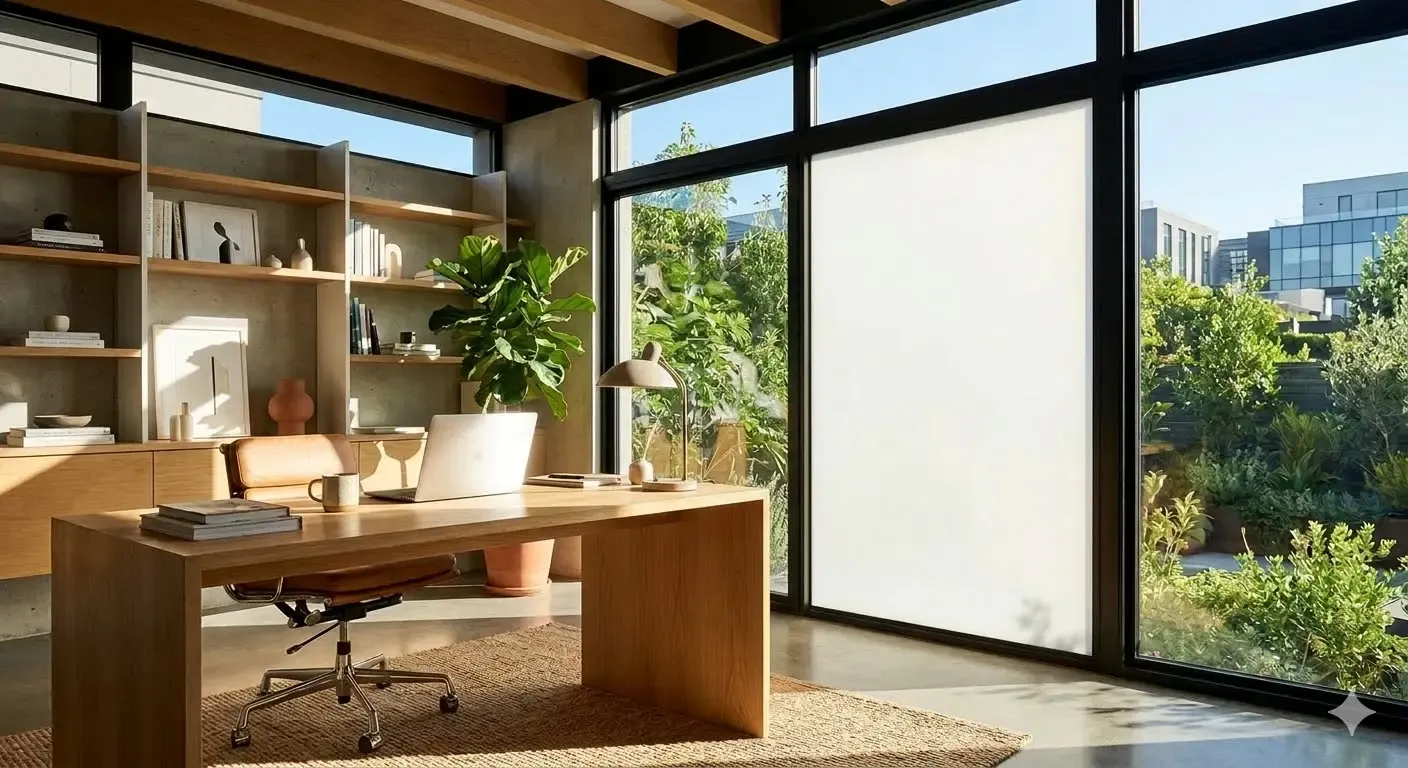
Budget privacy films promise clarity but deliver disappointment. Within months, bubbles form at the edges. The film yellows. Your "crystal-clear" window now looks like frosted glass. Why? Low-quality adhesive films have haze levels exceeding 5–8%, meaning light scatters unpredictably. You lose both privacy and visibility.
Heavy blinds block 100% of light—and 100% of your mental health. Research shows that prolonged darkness indoors increases fatigue and disrupts circadian rhythms. You're choosing between privacy and daylight. That's not a choice; it's a trap.
Frosted privacy films scatter light so aggressively that rooms feel cramped and dim. Light transmission drops below 50%. Your 200 sq ft office feels like a closet. The psychological impact is real: low natural light correlates with reduced focus and increased stress.
Traditional films are static. Opaque when you need it, opaque when you don't. You can't adjust privacy based on time of day, season, or mood. Modern life demands flexibility; old solutions don't deliver it.
Adhesive films require professional installation. Removal leaves residue. Blinds collect dust and break. You're locked into a solution that degrades over time.
Many buyers compare privacy products by appearance alone. But without checking measurable specs like haze, light transmission, and response time, it's easy to end up with a solution that looks good in marketing photos and disappoints in daily use.
Forget guesswork. Here's what to look for when evaluating any privacy solution:
Haze Level (%): Light scattering; higher means a cloudier view.
Light Transmission (%): The percentage of light that passes through the material.
Response Time: How fast privacy activates.
Viewing Angle: How clear the surface remains from the side.
Durability: Expected lifespan under daily use.
Solutions that meet these specs—haze under 2%, light transmission above 80%—maintain both privacy and daylight. You're not choosing between them anymore.

The window privacy industry is shifting toward electronically switchable technology—a category designed to deliver privacy on demand without relying on static frosting or mechanical coverings.
Instead of static films or mechanical blinds, the future is smart, switchable solutions. These solutions:
This isn't theoretical. It's already deployed in offices, homes, and commercial spaces worldwide. The technology uses liquid crystal alignment principles—the same science behind modern displays—to control light without physical barriers.
When comparing privacy options, focus on measurable performance first and aesthetics second. A solution that delivers fast switching, low haze, and high daylight transmission will outperform traditional films and blinds in everyday living.
Traditional window films and blinds force you to choose: privacy or daylight, clarity or control, aesthetics or function. Modern solutions eliminate that false choice.
When evaluating your next privacy upgrade, demand specifics. Ask for haze levels. Verify light transmission. Test response times. Don't accept vague promises like "crystal clear" or "natural light." The numbers tell the real story.
Ready to explore privacy solutions that don't sacrifice daylight? Discover how smart film technology is redefining window privacy for modern homes and offices.
Continue with focused product pages, planning tools, and your quote step.
Keep exploring closely related articles from the same topic space.
Smart film energy savings depend on film power use, glazing performance, climate, solar exposure, and controls. Compare
PDLC smart film provides rapid, power-off privacy by scattering light; SPD provides graduated glare and solar-brightness
PDLC provides instant privacy, electrochromic glass delivers slow predictive tinting, and SPD offers rapid, view-preserv
Get new implementation guides, use cases, and product-focused articles when they go live.